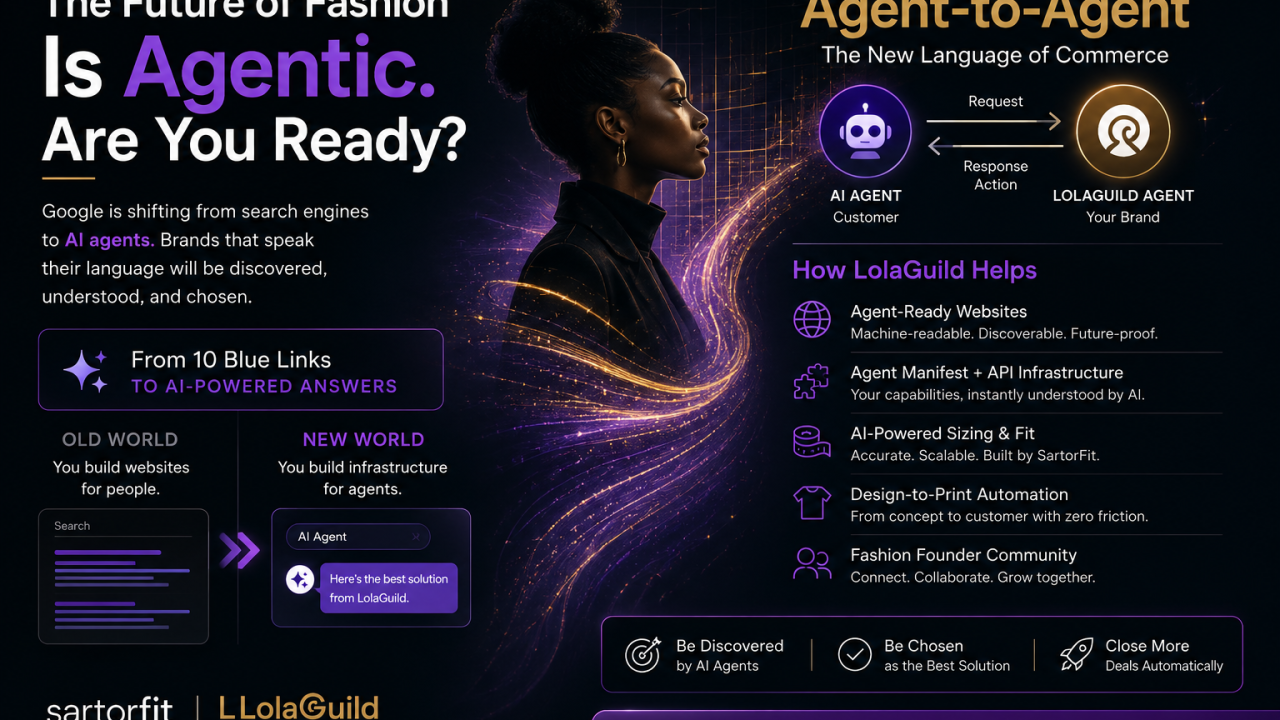
For over two decades, fashion brands have competed for one thing: the click. Build a website. Optimize for keywords. Rank on Google. Convert visitors into customers. The entire digital economy was built around that simple loop.
But at Google I/O 2026, the company unveiled its most radical overhaul of Search in 25 years a redesigned "intelligent" search box that dynamically expands and embeds AI agents directly into the interface. Sundar Pichai announced that Google’s goal for 2026 is to put AI agents at the forefront of all its biggest services: Search, Gmail, YouTube, Docs, and Chrome. AI Mode, now powered by Gemini 3.5 Flash, already serves over 1 billion users every single month.
This is not a gradual evolution. It is a structural break The Great Decoupling where visibility on Google no longer guarantees traffic, and the brands that win are not those with the most keywords, but those that machines can understand and act upon.
Fashion brands that adapt will dominate. Those that don't will become invisible. Here is exactly how you win.
Part 1: The End of the Click Economy
For years, Sundar Pichai has been quietly redefining what Search actually is. In a 2026 interview, he laid it out plainly:
"If I fast-forward, a lot of what are just information-seeking queries will be agentic in Search. You'll be completing tasks. You'll have many threads running."
Search is no longer just an information retrieval system. As Pichai recently explained, it is evolving into an "agent manager" a system that helps users move from research to real action without ever leaving the AI interface. At I/O 2026, Google doubled down: the company announced "information agents" that work in the background 24/7, scanning blogs, news sites, social posts, and real-time shopping data to deliver "intelligent, synthesized updates, with the ability to take action".
The shopping journey is collapsing. The new gateway is no longer a search results page. The new gateway is an autonomous AI agent.
Part 2: The Holy Grail — Agent-to-Agent Infrastructure
So what does a fashion brand need to do to be selected by these agents?
The answer is surprisingly simple and immediately actionable: you need an agent manifest in your website header.
The Architecture of Discovery
The Agent-to-Agent (A2A) Protocol is an open standard, originally developed by Google and now governed by the Linux Foundation, that enables AI agents to discover, communicate, and transact with each other across different frameworks and platforms. Since its release, more than 150 organizations have adopted it, with deep integration across Google Cloud, Microsoft Azure AI Foundry, and AWS Bedrock.
Here is how you use it.
Step 1: Link the Manifest in Your Application Header
Insert this single line into the <head> section of your website:
html
<link rel="agent-manifest" type="application/json" href="https://mybusiness.com/.well-known/agent-card.json" />
This tells every AI agent that discovers your site exactly where to find your machine-readable "capabilities card."
Step 2: Publish Your Agent Card
An Agent Card is the self‑describing manifest for an A2A agent. According to the A2A specification, it is published at /.well-known/agent-card.json and contains the agent's identity, capabilities, skills, security requirements, and preferred endpoint URLs. It functions as an enforceable contract — "a LinkedIn profile designed entirely for software".
Create a JSON file at https://mybusiness.com/.well-known/agent-card.json:
json
{
  "@context": "https://a2a-protocol.org/schema.json",
  "name": "Modern Furniture Co",
  "description": "Custom furniture manufacturer with AI-powered design consultation and made-to-order production.",
  "version": "1.0.0",
  "url": "https://modernfurnitureco.com",
  "capabilities": {
    "skills": [
      {
        "id": "room_design_assistant",
        "name": "AI Room Design Assistant",
        "description": "Generates furniture recommendations based on room dimensions and customer preferences.",
        "endpoint": "https://api.modernfurnitureco.com/v1/design"
      },
      {
        "id": "custom_order_builder",
        "name": "Custom Furniture Builder",
        "description": "Creates custom furniture quotes and production specifications automatically.",
        "endpoint": "https://api.modernfurnitureco.com/v1/orders"
      }
    ]
  }
}
Step 3: Add Supporting Discovery Files
To maximize agentic visibility, also add:
- /llms.txt : A plain‑text summary for LLM ingestion.
- /.well-known/ai.json : AI governance and discovery metadata.
- /sitemap.xml : Traditional, but still essential.
- robots.txt : Explicitly invite AI crawlers rather than blocking them.
This stack known as Agentic AI Optimization (AAIO) — is the new imperative. As a research paper by Luciano Floridi and colleagues formalized in April 2025, AAIO "explicitly optimises content for autonomous artificial agents, simultaneously addressing both human and machine interpretability". While SEO optimized for discoverability by humans through search engines, AAIO prepares websites for AI systems that initiate digital interactions independently.
Part 3: Why Most Fashion Websites Are Already Obsolete
Consider the data. Google's AI Overviews now has over 2.5 billion monthly active users. AI Mode has surpassed 1 billion. The company is rolling out Search Agents that users can create, customize, and manage to track shopping, finance, and real‑time information for them automatically.
Fashion brands still optimizing only for "human browsing" beautiful image grids, editorial lookbooks, and contact forms are building for a world that is rapidly disappearing. AI agents need structured data, machine‑readable APIs, and declarative capability manifests. Without them, you are invisible.
As Gap CTO Sven Gerjets told CNBC: "It's not just keyword search anymore. It's conversations. We need to be relevant to that."
Part 4: The New Economics of Agentic Commerce
The shift is already accelerating into real transaction volume.
RetailerAgentic InitiativeYearGapCheckout within Google Gemini first major fashion company to enable direct AI commerce2026 Ulta Beauty Collapsed entire discovery-to-checkout funnel into AI Mode and Gemini app, using Google's Universal Commerce Protocol2026OTB Group (Diesel, Margiela)Virtual Try‑On API with Google Cloud for client advisors2026
Gap now provides product details directly to Gemini in advance not crawled from its website ensuring accuracy and control over customer data. Shoppers check out via Google Pay, and Gap handles shipping.
The message is unmistakable: the brands that win are not competing against other brands. They are competing on machine readability.
Part 5: The Blueprint for Fashion Dominance
The path is clear. Here is how LolaGuild and SartorFit execute.
Phase 1: Discovery Optimization
Deploy the agent manifest link, agent card, and supporting discovery files. Ensure Google's agents can find you immediately.
Phase 2: Capability Exposure
examples sartorfit own
Your agent card must list specific "skills" ai_body_measurement, design_to_print, sizing_accuracy that an agent can call directly. When a user asks a shopping agent to "find a made‑to‑measure platform for independent designers backed by NVIDIA," your agent card should be the one that answers.
Phase 3: Transactional APIs
Open API endpoints that accept agent‑driven calls for measurement, fit prediction, and print workflow initiation. When an agent finds you, it should be able to execute on behalf of the user sending body data, generating pattern files, and initiating production without any human ever visiting a landing page.
Conclusion: The Future Belongs to Machine‑Readable Fashion
The agentic AI market is projected to grow from 7.7billionin2025to7.7billionin2025to48.4 billion by 2030, a CAGR of 44.6%. This is the largest shift in digital commerce since the birth of the browser.
The question is no longer whether agentic commerce will arrive. It is already here.
The question is whether your brand will be discoverable, understandable, and actionable when it does.
At SartorFit, we believe fashion is entering its fourth major era: agentic commerce. The first era was physical retail. The second was e‑commerce. The third was social commerce. The fourth is agent‑driven, machine‑to‑machine, API‑native commerce. LolaGuild is being built as the infrastructure for this fourth era not simply another fashion platform, but a business ecosystem designed for the next generation of discovery, automation, and transaction.
Add the manifest. Build the card. Open your APIs.
And position your brand not just for visibility in the age of agents but for dominance.
Citations
Google AI Mode Usage & Gemini 3.5 Flash Google's AI Mode surpassed 1 billion monthly active users globally within one year of launch. The report, published alongside Google I/O 2026 announcements on May 20, 2026, stated that queries have more than doubled every quarter. Gemini 3.5 Flash was announced as the new default model for AI Mode. The information agents feature persistent AI systems that continuously scan the web on a user's behalf — was also unveiled at the conference.
Sources:
- "Google Shares First AI Mode Usage Data After One Year" — Search Engine Journal (May 20, 2026)
- "At Google I/O 2026, Alphabet rewrites search playbook, unveils Gemini 3.5 Flash" — The Hindu (May 20, 2026)
- "One Year of Google AI Mode: Longer Queries, Smarter Shoppers, Multimodal Search" — CMSWire (May 22, 2026)
- "Google I/O 2026: All the Major AI Announcements" — eWeek (May 20, 2026)
Sundar Pichai on Agentic Search In an interview published in April 2026, Sundar Pichai stated that Search will evolve into an "agent manager" a system where "information-seeking queries will be agentic," users "complete tasks," and "many threads run" simultaneously. He emphasized that Search will orchestrate actions across multiple AI agents rather than simply returning ranked results.
Source:
- "Google's CEO Predicts Search Will Become An AI Agent Manager" — Search Engine Journal (April 9, 2026)
- "What I Learned About The Future Of Search And AI From Sundar Pichai's Latest Interview" — Search Engine Journal (April 10, 2026)
Agent-to-Agent (A2A) Protocol On April 9, 2026, the Linux Foundation announced that the A2A (Agent-to-Agent) Protocol originally developed by Google and contributed to the foundation now has more than 150 organizations supporting the standard. The protocol is deeply integrated across Google Cloud, Microsoft Azure AI Foundry, and AWS Bedrock. The Agent Card is published at /.well-known/agent-card.json, serving as a machine-readable JSON descriptor containing the agent's identity, capabilities, skills, and endpoints.
Sources:
- "A2A Protocol Surpasses 150 Organizations, Lands in Major Cloud Platforms, and Sees Enterprise Production Use in First Year" Linux Foundation Press Release (April 9, 2026)
- "Linux Foundation A2A Protocol Marks One Year with Broad Enterprise and Cloud Adoption" HPCwire (April 9, 2026)
- "AI智能体协议战:谷歌A2A能否打破'孤岛'并重塑互操作性?" Neican AI (June 25, 2025)
Agentic Commerce and Retail Partnerships Google Cloud announced the agentic commerce era on January 12, 2026, positioning AI agents as "capable of executing complex, multi-step actions autonomously across every consumer touchpoint."
Gap became the first major fashion retailer to launch direct checkout within Google Gemini on March 24, 2026. Gap CTO Sven Gerjets stated: "It's not just keyword search anymore, right? It's conversations, and so we need to be relevant to that."
Ulta Beauty announced its agentic commerce integration with Google on April 22, 2026, collapsing the entire beauty funnel discovery, comparison, and checkout into a single conversational interaction powered by Google's Universal Commerce Protocol. Mike Maresca, Ulta Beauty's CTO, commented: "The next era of commerce will be shaped by how well retailers turn AI into practical, scalable capabilities."
Sources:
- "A new era of agentic commerce is here" Google Cloud Blog (January 12, 2026)
- "Gap Becomes First Retailer To Launch AI Checkout In Google Gemini" MediaPost (March 24, 2026)
- "Gap says it will launch checkout within Google's Gemini, in an AI first from a major fashion company" CNBC (March 24, 2026)
- "Ulta Beauty and Google Launch AI Shopping That Collapses the Beauty Funnel" BeautyMatter (April 24, 2026)
- "Ulta Beauty and Google Introduce Gemini-Enabled Shopping Experiences That Streamline Beauty Discovery and Purchase" Google Cloud Press Corner (April 22, 2026)
- "Ulta Beauty, Google partner on agentic commerce launch through Gemini" — Digital Commerce 360 (April 22, 2026)
OTB Group Virtual Try-On On May 7, 2026, OTB Group (parent company of Diesel, Jil Sander, Maison Margiela, Marni, and Viktor&Rolf) launched a Virtual Try-On API with Google Cloud, enabling client advisors to share hyper-realistic visual previews of garments with customers.
Source:
- "OTB Group and Google Cloud Launch AI-Powered Hyper-Personalized Shopping Experiences" — TMCnet (May 7, 2026)